.png)

The Fascinating World of Wasps in Jamaica 🐝🇯🇲

Jamaica is home to a diverse range of wasps, from powerful predators to crucial pollinators. While often feared, these insects play a vital role in maintaining ecological balance. Here are ten fascinating facts about Jamaican wasps that may surprise you!
1. The Caribbean Paper Wasp Is Native to Jamaica
The Caribbean Paper Wasp (Polistes crinitus) is commonly found across the island. These social wasps build open-comb nests under roofs, on trees, and even in urban spaces. Despite their fearsome reputation, they play an essential role in controlling pest populations.

📝 Source: Wildlife Jamaica, 2019
2. The Jamaican Digger Wasp Hunts Spiders
The Jamaican Digger Wasp (Sphex jamaicensis) is known for its unique hunting method. It paralyzes spiders and buries them alive as food for its larvae. This solitary wasp is a fierce predator but is harmless to humans unless provoked.

📝 Source: BugGuide.Net
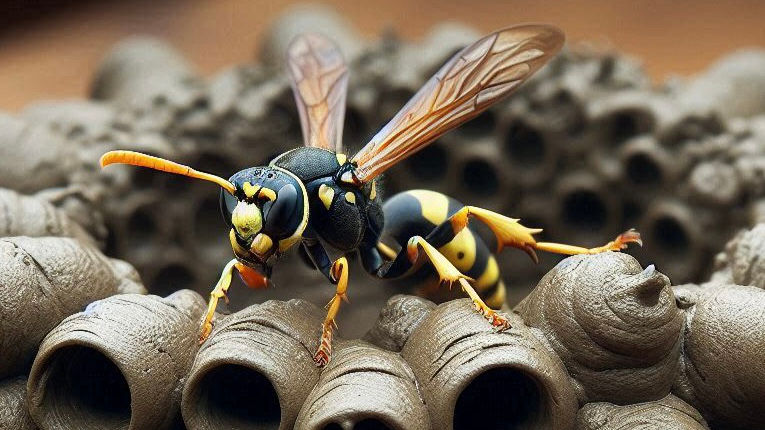
3. Mud Daubers Build Their Nests from Mud
Wasps from the Sceliphron genus, like Sceliphron assimilé, construct mud nests in sheltered locations. These wasps are known for their precision in crafting nest chambers, each containing a paralyzed spider for their developing larvae.
📝 Source: Brockmann & Dawkins, 1978
4. Some Wasps Pollinate Coconut Trees
Wasps are not just predators—they can be pollinators too! Studies have shown that wasps, along with honeybees, help pollinate coconut trees (Cocos nucifera) in Jamaica, supporting fruit production.

📝 Source: ResearchGate
5. The Keyhole Wasp Can Take Over Other Wasps’ Nests
The Keyhole Wasp (Pachodynerus nasidens) is known for its unusual nesting behavior. It sometimes repurposes old paper wasp nests instead of building its own. These wasps have even been found nesting in keyholes, giving them their name.

📝 Source: Journal of Hymenoptera Research, 2022
6. Night Wasps Exist in Jamaica
While most wasps are active during the day, some species in Jamaica, such as those from the Ophioninae subfamily, are nocturnal. They are often attracted to lights at night and play a role in controlling caterpillar populations.

📝 Source: Wildlife Jamaica, 2020
7. Some Wasps Are Tiny Parasites
Jamaica is home to many parasitic wasps, such as those from the Ichneumonidae family. These tiny wasps lay their eggs inside other insects, particularly caterpillars, keeping pest populations in check.

📝 Source: Journal of Hymenoptera Research, 2007
8. Some Jamaican Wasps Are Invasive
While most wasp species in Jamaica are native, some, like the European Paper Wasp (Polistes dominula), have been introduced and are competing with local species for resources.

9. Wasps Have Impressive Memory Skills
Studies suggest that paper wasps can recognize individual faces of their colony members and remember past encounters, helping them maintain social order.

10. Wasps Are Used for Pest Control
Farmers in Jamaica sometimes encourage wasp populations to naturally control insect pests, reducing the need for chemical pesticides.

Final Thoughts
Wasps are more than just stinging insects; they are pollinators, pest controllers, and master architects that contribute to Jamaica’s biodiversity. The next time you spot one, take a moment to appreciate its role in the ecosystem!
Sources
• “Wasp and Bee Species.” Rentokil Pest Control Jamaica, Rentokil Initial, https://www.rentokil.com/jm/services/pest-control-services/wasps/species.
• Hanson, Paul E., and Ian D. Gauld. “Parasitoid Wasps from Three Jamaican Localities: A Pilot Study.” Journal of Hymenoptera Research, vol. 16, 2007, pp. 45–67, https://jhr.pensoft.net/article/1656/.
• “Polistes crinitus.” iNaturalist, https://www.inaturalist.org/taxa/202229-Polistes-crinitus.
• Brockmann, H. Jane, and Charles J. Dawkins. “The Biology in Jamaica of the Adults of the Sphecid Wasp Sceliphron Assimile Dahlbom.” Ecological Entomology, vol. 3, no. 3, 1978, pp. 199–206, https://resjournals.onlinelibrary.wiley.com/doi/abs/10.1111/j.1365-2311.1978.tb00901.x.
• “Sphex jamaicensis – Jamaican Digger Wasp.” BugGuide.Net, Iowa State University, https://bugguide.net/node/view/56796.
• “Nesting of the Keyhole Wasp Pachodynerus Nasidens (Latreille) on a Paper Wasp’s Nest in Jamaica.” Journal of Hymenoptera Research, vol. 91, 2022, pp. 187–192, https://jhr.pensoft.net/article/91298/.
• “Ophioninae (Night Wasp) Is a Subfamily of Ichneumonidae.” Wildlife Jamaica, Facebook, 15 May 2020, https://www.facebook.com/photo.php?fbid=2047747012280115.
• “Pollination of Coconut (Cocos Nucifera L.) in Jamaica by Honeybees and Wasps.” ResearchGate, https://www.researchgate.net/publication/240431012_Pollination_of_coconut_Cocos_nucifera_L_in_Jamaica_by_honeybees_and_wasps.
• “Caribbean Paper Wasp (Polistes Crinitus).” Wildlife Jamaica, Facebook, 20 Aug. 2019, https://www.facebook.com/WildlifeJamaica/posts/caribbean-paper-wasp-polistes-crinitus-the-caribbean-paper-wasp-is-native-to-jam/1612038455850975/.
• “Sphex jamaicensis.” Wikipedia, Wikimedia Foundation, https://en.wikipedia.org/wiki/Sphex_jamaicensis


Comments