.png)

Did Earth’s Water Come from the Moon? A Shocking Lunar Discovery💧🌙💡
- Jupitaz Moon

- Feb 21, 2025
- 3 min read
For decades, scientists have debated the origins of Earth’s water. Some theories suggest that water arrived via comets or asteroids, while others point to volcanic activity on early Earth. But what if the answer has been right above us this whole time? 🌙💧
A groundbreaking study has revealed that the Moon may have played a role in Earth’s water supply—challenging everything we thought we knew about our planet’s history.
Water on the Moon? A Surprising Discovery


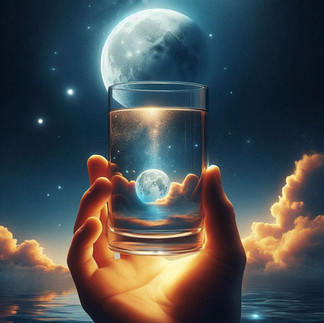
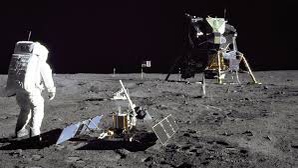

For most of history, scientists believed the Moon was completely dry. Since the Apollo missions, lunar samples had shown little evidence of water, leading many to dismiss the possibility. However, recent studies have proven otherwise.
In 2017, researchers analyzing tiny volcanic glass beads—collected from the Moon by Apollo astronauts—discovered that these beads contained water trapped inside (Saal et al.). This finding shocked the scientific community and raised a fascinating question:
Could these water-rich lunar particles have made their way to Earth?
How Could the Moon Have Contributed to Earth’s Water?

Billions of years ago, the Moon was far more geologically active. Massive volcanic eruptions spewed clouds of molten rock, gas, and—most importantly—water vapor into space. Some scientists believe that during this period:
1. Water vapor from lunar eruptions escaped into space.
2. Some of these particles were pulled into Earth’s atmosphere by gravity.
3. Over millions of years, this process helped contribute to our planet’s growing water supply.
If this theory holds true, it would mean that the Moon is not just Earth’s tidal companion—but also a key player in making our planet habitable. 🌍
What This Means for Space Exploration

This discovery changes how we think about the Moon and its potential resources. Scientists now believe that:
• There may be large reservoirs of water beneath the Moon’s surface. 🌕
• Future lunar missions could extract this water for drinking, fuel, and long-term space exploration. 🚀
• Other celestial bodies may hold more water than we previously thought, increasing the chances of finding life beyond Earth. 👽
NASA and other space agencies are now planning lunar missions to explore water deposits in permanently shadowed craters. If we can harness this water, it could be a game-changer for Moon bases and deep-space travel (Li et al.).
The Bigger Picture: Rethinking Earth’s Origins

If some of Earth’s water came from the Moon, it raises even bigger questions:
🔹 What else did the Moon contribute to Earth’s development?
🔹 Could this process have happened elsewhere in the universe?
🔹 Are we closer to finding extraterrestrial life?
While we don’t have all the answers yet, one thing is certain—the Moon isn’t just a barren rock. It may hold the key to our planet’s most fundamental mysteries.
The next time you take a sip of water, just think… you might be drinking a little piece of the Moon. 🌙💙

Works Cited
Li, Shuai, et al. “Direct evidence of surface exposed water ice in the lunar polar regions.” Proceedings of the National Academy of Sciences, vol. 115, no. 36, 2018, pp. 8907-8912.
Saal, Alberto E., et al. “Volatile content of lunar volcanic glass beads: Implications for the formation and evolution of the Moon.” Nature Geoscience, vol. 1, no. 2, 2008, pp. 144-148.
What do you think? Could Earth’s water really have come from the Moon? Drop a comment below! 🚀💬 #JupitazMoon #SpaceMysteries #LunarScience


Comments